The First Documented Record of the Shikra in Kurdistan.
This may be the first documented record of a Shikra in Kurdistan.
It was very early in the morning when I drove approximately 120 kilometres from Erbil to the Barzan area, near Ble, to photograph and record the beautiful song of the Common Nightangle.
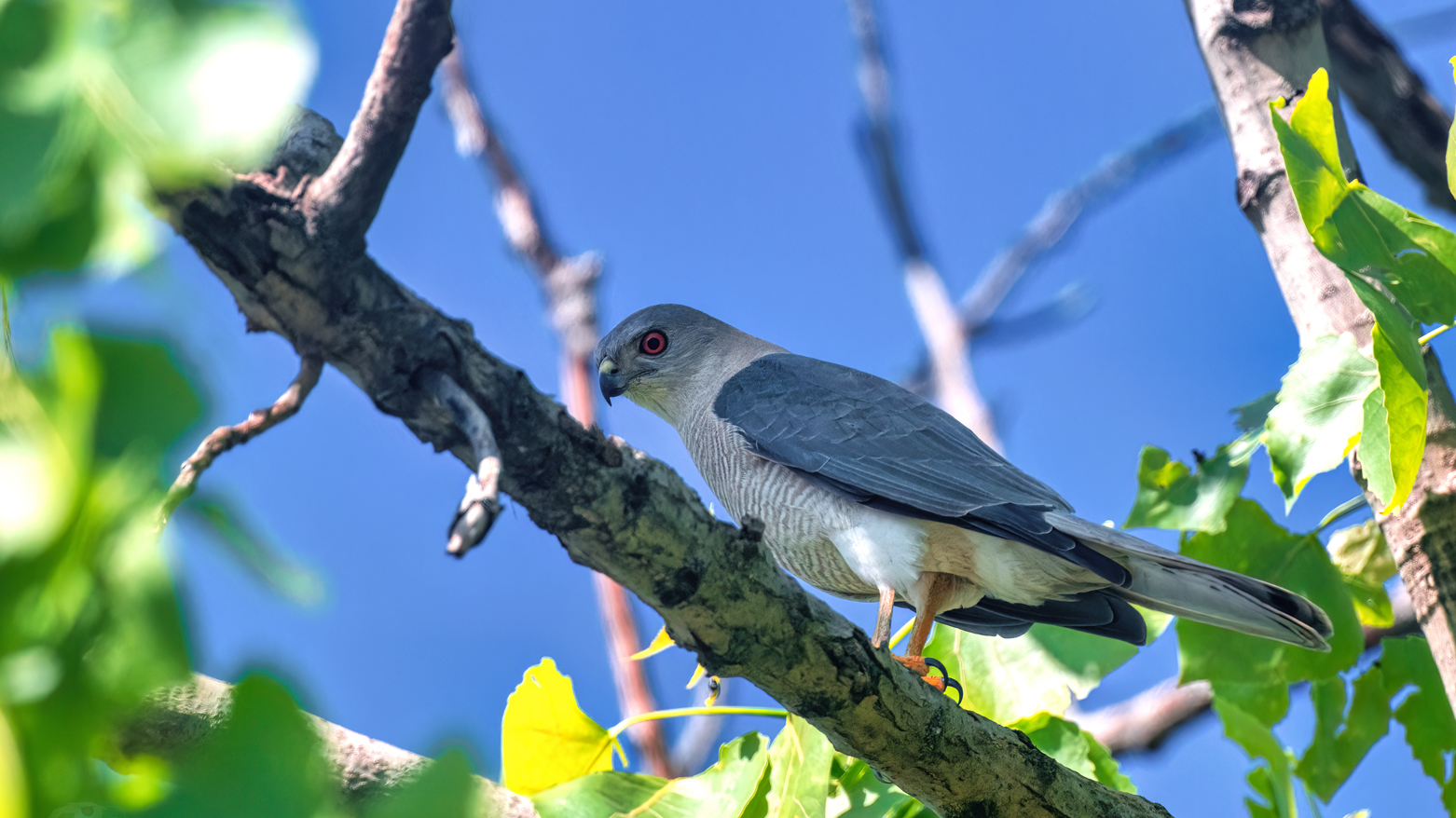
After photographing the bird, I came out of my hide. A few minutes later, the shadow of a bird of prey passed over my head. At first, I thought it was a Eurasian Sparrowhawk. However, after taking a photograph and examining it closely, I noticed its reddish iris and other distinctive features, which suggested that it was not a Eurasian Sparrowhawk.
Its flight and behaviour were also different from those of the Eurasian Sparrowhawk, a species commonly seen in Kurdistan and locally known as “Bashoka.”
To confirm my identification, I consulted Dr. Korosh Ararat, a biodiversity expert, as well as an Italian expert. They confirmed that the bird was a Shikra, a species that, to the best of our knowledge, had not previously been documented in Kurdistan or Iraq.
Shikra (Accipiter badius)
This observation represents a potential new record for the bird lists of Kurdistan and Iraq. We are working to have this record formally recognised and included in the relevant regional and national bird lists.
The Shikra has sometimes been misidentified as a Eurasian Sparrowhawk because the two species share several physical characteristics. Distinguishing them requires careful observation of their plumage, iris colour, proportions, flight patterns, and other identifying features.
The Shikra is a fast, agile, and active bird of prey, capable of manoeuvring skilfully through trees and dense vegetation while pursuing its prey. Its hunting techniques and behaviour make it a fascinating species to observe in the field.
Identification and Physical Characteristics
The Shikra is a small bird of prey, measuring approximately 26–30 cm in length. Like many other small hawks, it has relatively short, rounded wings and a narrow, somewhat long tail.
Adults have grey upperparts and whitish underparts marked with fine, reddish-brown barring. The lower belly is less heavily barred, and the thighs are whitish. Adult males typically have a reddish iris, whereas females usually have a yellowish-orange iris and browner upperparts, with heavier barring on the underparts. Females are slightly larger than males. A narrow, dark mesial stripe runs down the throat.
Distribution and Range
The Shikra has an extensive distribution across Asia and parts of Africa. However, documenting its regional distribution, breeding populations, and local nesting behaviour remains important for ornithologists, field researchers, and wildlife photographers.
Asian range: Its distribution extends from parts of the southern Caucasus and the Middle East across the Indian subcontinent and into Southeast Asia and southern China.
African range: Its African distribution covers a broad area of sub-Saharan Africa, extending from Senegal in the west towards Ethiopia and Somalia in the east.
Key Facts
• Scientific name: Accipiter badius
• Length: Approximately 26–30 cm (10–12 inches)
• Diet: Small birds, lizards, rodents, large insects, and occasionally frogs
• Habitat: Woodlands, farmland, gardens, parks, and some urban environments
• Flight style: Fast and agile, with the ability to make sudden turns when pursuing prey through trees
For me, this observation was a particularly exciting moment in the field. What began as an early-morning trip to photograph a singing Common Nightingale turned into a potentially significant discovery for the birds of Kurdistan.